Mandara: A Practical Evaluation of Decorative Dingbat Typography
In the current digital landscape, where visual noise is constant, finding specific assets that offer both aesthetic appeal and functional ease can be a challenge. For designers, marketers, and content creators, the ability to quickly integrate complex decorative elements without relying on heavy image files is a significant workflow advantage. This brings us to Mandara, a typeface that moves beyond standard alphanumeric characters to offer something distinct: a curated set of intricate mandala designs accessible through standard keystrokes.
Understanding the Dingbat Category
Before diving into the specific utility of Mandara, it is important to understand the category of "dingbats." In typography, a dingbat font is one where the glyphs are not letters or numbers, but rather symbols, shapes, or illustrations. Historically, these were simple bullets or arrows (like the ubiquitous Wingdings). However, modern iterations of this concept, such as Mandara, have evolved significantly. They now serve as vector libraries embedded within a font file. This allows users to scale intricate designs—such as hand-drawn mandalas—to any size without pixelation, making them versatile tools for both print and digital media.
Visual Characteristics and Aesthetic Quality
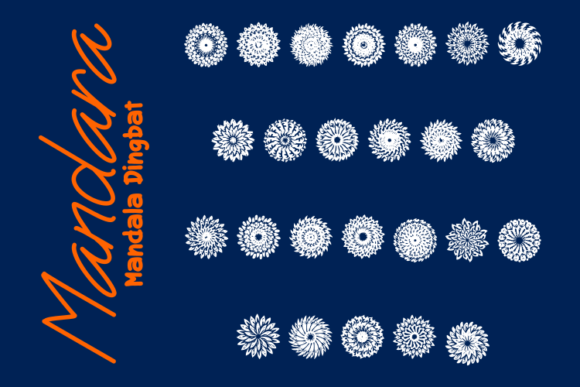
The defining feature of Mandara is its focus on the mandala, a geometric configuration of symbols often used in spiritual and artistic contexts. The design language of this font leans heavily into the "handmade" aesthetic. Unlike sterile, algorithmically generated geometric shapes, the glyphs in Mandara possess a subtle organic quality. The lines are not mathematically perfect; they mimic the slight imperfections of hand-drawing, which adds warmth and authenticity to the final output.
The complexity of the designs varies. Users will find that the font includes a range of patterns, from simple, symmetrical borders to dense, concentric circles that function as standalone focal points. This variation is crucial because it allows the asset to be used for different purposes—some glyphs work as background textures, while others serve as the centerpiece of a logo or header design.
Practical Application in Design Workflows
For professionals, the value of a resource is often measured by its efficiency. Mandara excels in this regard because it integrates seamlessly into existing workflows. Because the designs are accessed via a font file, they are compatible with virtually any software that supports text editing. This includes Adobe Creative Cloud (Photoshop, Illustrator, InDesign), Canva, CorelDRAW, and even standard office presentation software.
There is no need to import vector paths or manage linked assets. A user can simply select the Mandara font, type the corresponding character on their keyboard, and the mandala appears. This simplicity allows for rapid prototyping. For example, a social media manager can quickly add a decorative frame to an Instagram post, or a blogger can create a unique divider between article sections in seconds.
Scalability and Resolution Independence
One of the most significant technical advantages of Mandara is its vector nature. In an era where content must be responsive across multiple devices and print sizes, resolution independence is non-negotiable. Whether the design is intended for a small favicon or a large-format banner print, the lines remain crisp. This reliability ensures that the quality of the asset does not degrade as the project scales, a common pitfall when using raster-based clipart.
Target Audience and Use Cases
While the aesthetic is specific, the application of Mandara is surprisingly broad. It is particularly useful for specific segments of the creative market.
- Stationery and Wedding Invitations: The mandala style aligns perfectly with the bohemian and organic trends popular in stationery. Designers can use Mandara to create wax-seal effects or ornate borders for wedding suites.
- Adult Coloring Books: For publishers in the niche of coloring books, this font offers a quick way to generate complex patterns that users can color in. The outlines are clear and distinct, which is a requirement for this medium.
- Apparel and Merchandise: T-shirt designers often look for unique graphics. Using Mandara, a creator can place a large, detailed mandala on a garment. Because it is a vector, it translates well to screen printing and Direct-to-Garment (DTG) processes.
- Digital Scrapbooking and Junk Journaling: The "handmade" feel of Mandara resonates strongly with the digital scrapbooking community. It provides texture and visual interest without the need for scanning physical items.
Evaluating Usability and Flexibility
When evaluating a resource like Mandara, it is necessary to consider its flexibility within a color palette. As a font, the color of the mandala is determined by the text color setting in the design software. This offers immense flexibility. A user can apply gradients, textures, or solid colors to the glyphs with a single click. This adaptability means a single font file can generate hundreds of visual variations, effectively increasing its return on investment.
However, it is worth noting the nature of dingbat fonts. They do not behave like text fonts; you cannot spell words with them. This requires a slight mental shift for new users. You are essentially using a keyboard as a remote control for a library of images. While this is efficient once mastered, it can sometimes be difficult to remember which key corresponds to which specific mandala design. Keeping a reference sheet (often provided by the font creator) nearby is a practical recommendation for maximizing efficiency.
Limitations and Considerations
No asset is perfect for every scenario, and Mandara has its constraints. The primary limitation is stylistic consistency. If a project requires a strict, corporate, or minimalist aesthetic, the ornate and "handmade" nature of these mandalas may clash with the overall design language. The designs are inherently decorative and carry a specific bohemian or spiritual vibe.
Additionally, while the font is scalable, the level of detail in some of the denser glyphs can pose challenges in very small sizes. If a user attempts to use a highly complex mandala from the Mandara set as a 12-pixel icon, the intricate lines may merge and become illegible. In such cases, selecting simpler glyphs from within the font set is necessary.
Licensing and Commercial Use
As with any creative asset, professionals must verify the licensing terms. While Mandara is widely available, the terms for commercial use (such as on merchandise for sale) can vary depending on the distributor. It is always best practice to review the End User License Agreement (EULA) to ensure the intended use is covered, particularly for print-on-demand services.
Conclusion: Is Mandara the Right Asset?
For creators seeking to add a touch of intricate, hand-drawn artistry to their work, Mandara presents a compelling solution. It bridges the gap between complex vector illustration and user-friendly typography. The font offers a practical way to incorporate high-quality, scalable mandala designs into a variety of projects, from wedding stationery to digital branding.
Its strength lies in its ability to democratize complex design elements. You do not need to be an expert illustrator to use these designs; you simply need to know how to type. While it is stylistically specific, for those working within the realms of boho, organic, spiritual, or decorative design, Mandara is a reliable, high-quality tool that can significantly streamline the creative process. By treating typography as an image library, it empowers users to enhance their artistic side efficiently and effectively.